
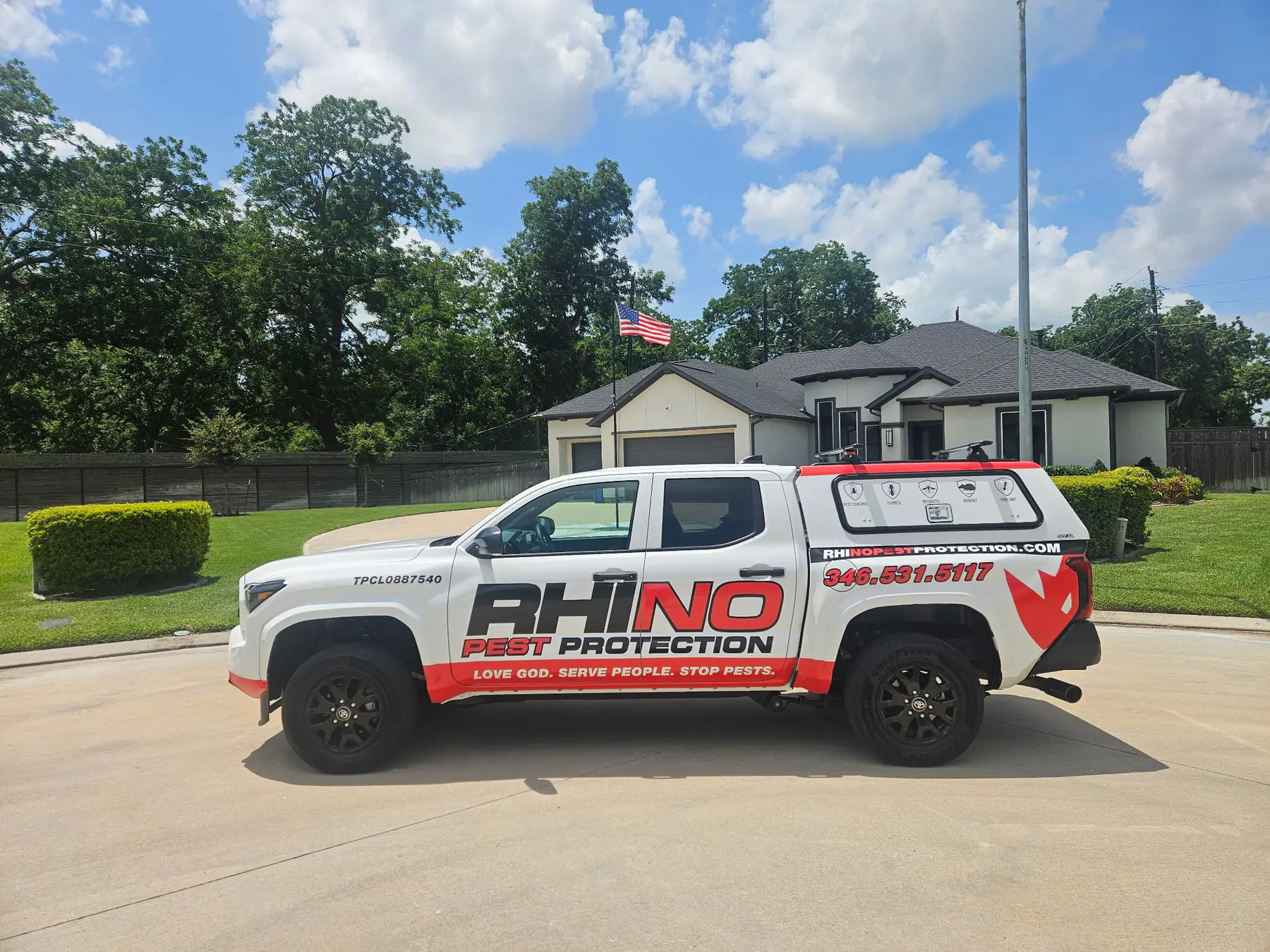
Rhino Pest Protection provides roach control across Greater Houston, and quarterly service starts at $104 per visit covering American and smokybrown cockroaches along with ants, spiders and wasps.
German cockroach treatment is a separate service at Rhino Pest Protection and is quoted on its own after a free estimate, because clearing an indoor breeding population takes repeat interior work beyond what a standard quarterly visit covers. Rhino Pest Protection works from one office in Richmond, TX.
Which cockroach you have decides the treatment
Three species account for most of what shows up in Greater Houston homes.
- American cockroach. Large, reddish brown, usually coming in from drains, garages, and door gaps. An outside pest that got inside.
- Smokybrown cockroach. Also large, common in the Gulf Coast, drawn to mulch beds, wood piles, and attics.
- German cockroach. Small and tan, and the one that changes everything. It breeds indoors, lives in kitchens and bathrooms, and does not need to come in from outside at all.
The first two are what the quarterly plan is built for. Exterior barrier treatment, entry-point work, and dusted weep holes stop the ones trying to get in.
Why German cockroaches are quoted separately
German cockroaches live in appliance voids, cabinet cracks, and the warm spaces behind kitchen equipment.
They reproduce fast, and an exterior perimeter never touches them, because they were never outside.
Clearing them takes repeat interior treatment. Baiting where they harbor, crack-and-crevice work along plumbing penetrations and baseboards, and follow-up visits to catch what hatches after the first round.
That is a different amount of work than a quarterly stop, so Rhino prices it as its own service instead of folding it into a plan and hoping.
What the quarterly visit does about roaches
The first visit includes interior treatment under sinks, in the garage, and in the utility room, plus exterior treatment around awnings, eaves, windows, doors, weep holes, and the foundation. Ongoing visits typically focus on the exterior, with interior treatment available when you request it.
Weep holes matter more than most homeowners expect. They open straight into the wall cavity, and on Gulf Coast slab homes that is a highway for roaches.
The foundation gets treated, and the walkway and driveway get blown off so debris is not left sheltering anything.
Signs you have more than one roach
Seeing a roach in daylight usually means the harborage is already established. Daylight activity is a crowding behavior.
- Droppings that look like coarse pepper near cabinets and baseboards.
- Egg cases tucked into cracks and appliance voids.
- Shed skins, since roaches molt as they grow.
- A musty odor in enclosed cabinets or under sinks.
Sanitation and moisture do half the work
Roaches need water more urgently than food. A dripping trap under a sink will hold a population that no treatment schedule can outrun.
The practical list is short. Fix slow leaks, dry the sink at night, keep cardboard out of the pantry and garage, and clean appliance voids where grease collects.
None of that replaces treatment. It decides how long treatment lasts.
Pricing and coverage
| Service | Covers | Price |
|---|---|---|
| Quarterly pest control | American and smokybrown cockroaches, plus ants, spiders, and wasps | $104 initial, then $104 quarterly |
| German cockroach treatment | Interior baiting, crack-and-crevice work, and follow-up visits | Quoted separately after inspection |
Prices are plus tax and current as of August 2026. Estimates are free.
If covered roaches come back between scheduled visits, Rhino provides return service at no charge and generally responds within 24 hours. That is the Rhino Promise.
Homes, businesses, and managed properties
Restaurants, multifamily housing, HOA boards, and property managers get documented service plans through commercial pest control, where German cockroach work is the most common call.
For a city-level look at roach service, see roach control in Fulshear, TX.
Common questions about cockroach control
-
Does quarterly pest control cover cockroaches?
Yes, for the roaches that wander in from outside. American and smokybrown cockroaches are on the standard pest list covered by the quarterly plan. German cockroaches are a different problem and are quoted as their own service.
-
Why are German cockroaches treated separately?
German cockroaches breed indoors, hide in appliance voids and cabinet cracks, and multiply faster than a perimeter treatment can keep up with. Clearing them takes repeat interior work, not a quarterly exterior barrier. Charging for it separately is the honest way to price it.
-
How do I know which roach I have?
Size and location are the tell. German cockroaches are small, tan, and stay near kitchens and bathrooms. American and smokybrown roaches are much larger and usually turn up near doors, garages, and drains after coming in from outside.
-
What are the signs of a roach problem besides seeing one?
Droppings that look like coarse pepper near cabinets and baseboards, egg cases tucked into cracks, shed skins in appliance voids, and a musty odor in enclosed spaces. Seeing one during daylight usually means the harborage is already established.
-
Why did store-bought roach spray not fix it?
Sprays kill what they contact and scatter the rest deeper into the wall voids and appliance cavities where they breed. Baiting and crack-and-crevice work reaches the harborage instead of pushing it further out of reach.
Get an honest answer about your roaches
Tell us where you are seeing them and what time of day. That usually narrows the species before anyone walks the property.
- Call 346-531-5117 — Crosby, Gary, or Matt answers.
- Request a free estimate — quoted in writing after an inspection.
Love God. Serve People. Stop Pests. — Gary Kirkowski, Founder